IThe Hand on the Board
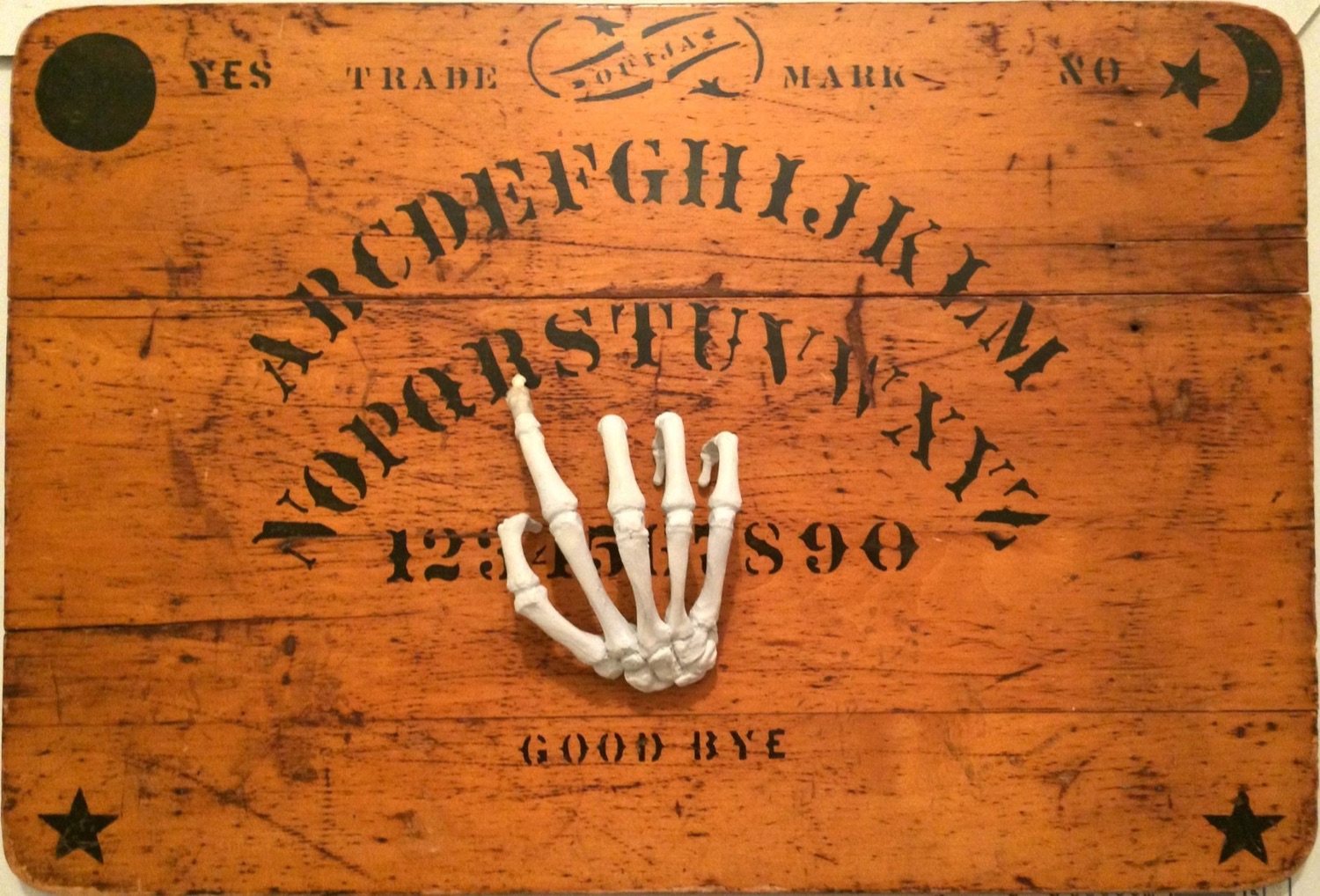
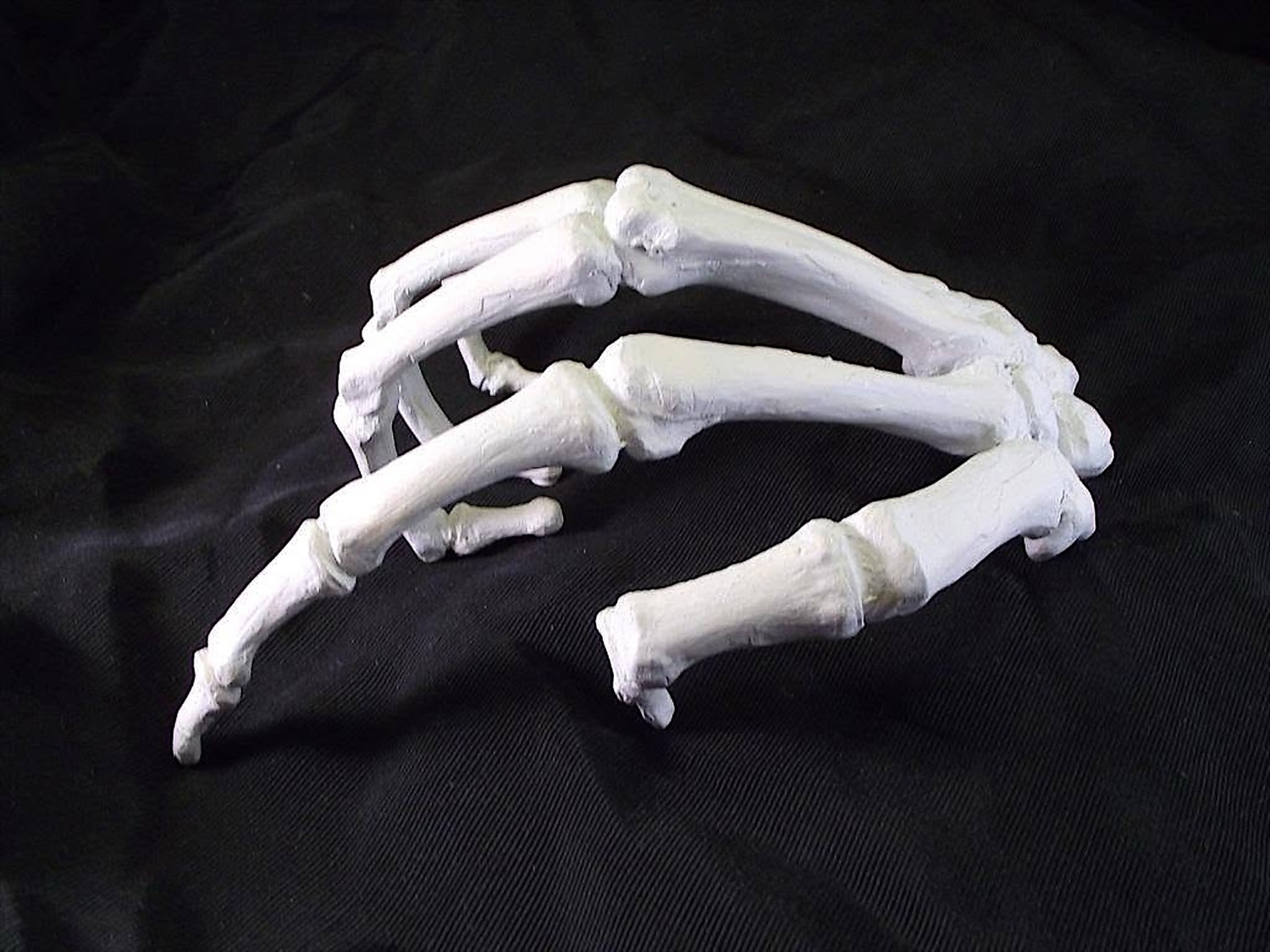
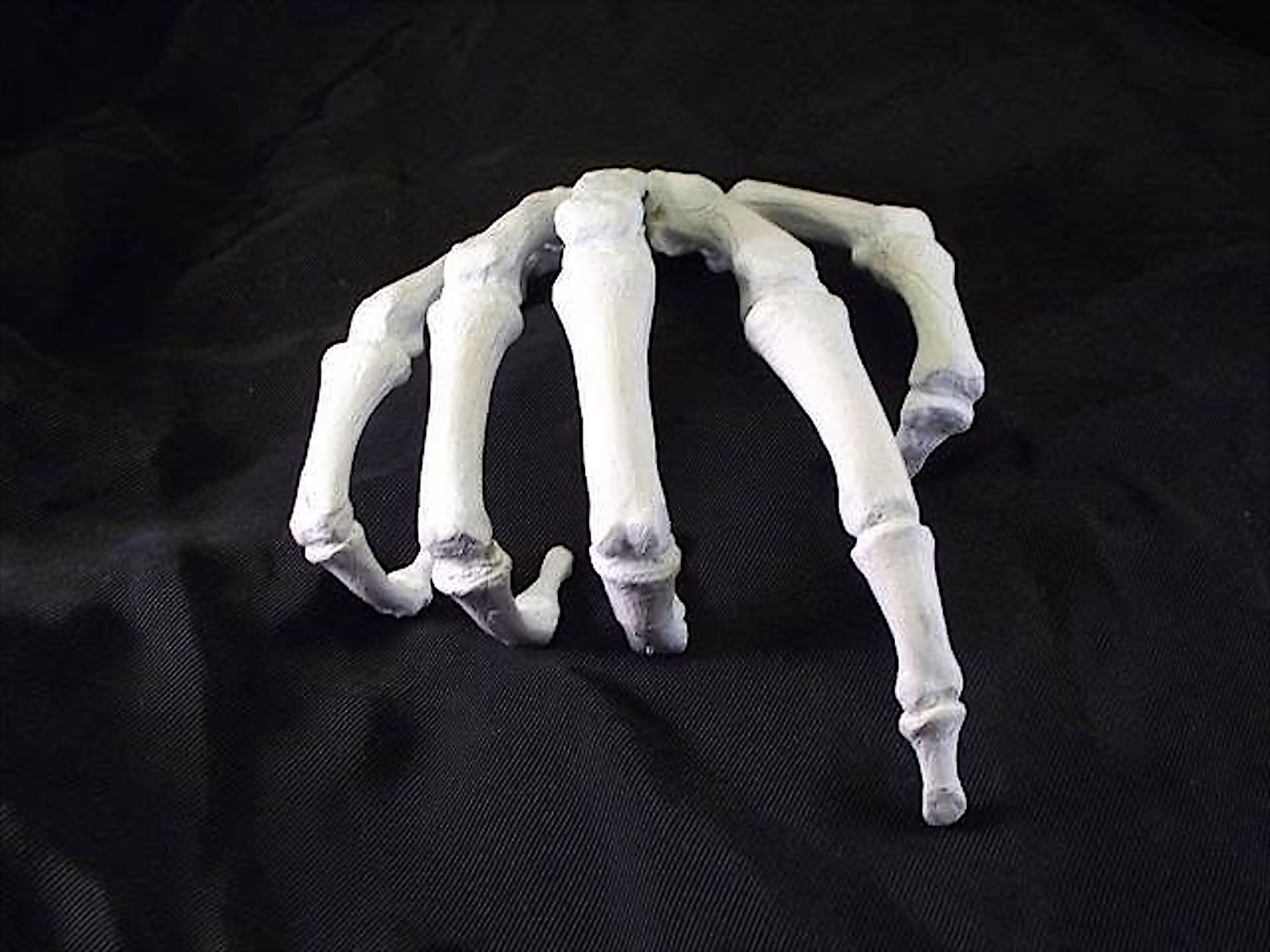
Every planchette ever made has had the same problem: it is a proxy. The sitters’ fingers rest on a small board, the board slides, and a window or a pointer tells you where it stopped. Between the hand and the answer is a piece of wood, and the piece of wood is mute. The skeletal planchette removes the wood. It is a hand, the right size, with the right bones in the right places, that rests on the board under your fingers and moves as any planchette moves; and when it stops over a letter the fingertip comes down and taps, once, on the board, and the letter is not merely pointed to but sounded. The sitters hear the answer as they see it. Nobody has to say ‘it’s on the K’. The K knocks.
What moves it is what moves every planchette: the hands on it, and in the hands the small involuntary motions that Chevreul named in 1833 and that the physiologists call ideomotor. That is not a confession; it is the mechanism, and the skeletal hand uses it more fully than any pointer ever has. The tap is a reflex. When the board slows under the letter, the sitters’ fingers settle, the weight of the hand shifts onto the extended finger, and the tip strikes. With practice the tap becomes crisp and deliberate, in exactly the way that a pianist’s fingers become crisp: not by thinking about them but by playing. The talking board has always been an instrument. This one has a hammer.
And because it has a hammer it can be used alone. Set on a bare table, without any board at all, the hand raps: one, two, three, the counted alphabet, the whole protocol of the séance as it was practised in 1848 before there was a board to point at. That is the older use, and it is the one this page is really about. A skeleton hand that raps is not a novelty. It is the rapping hand of the Victorian stage, the enchanted skull of Robert-Houdin, the rapping table of the spiritualist parlour, and the knocking in the walls at Hydesville, all in one object, made properly for the first time.
IIThe Ouija Board, from the Beginning
The board under the hand has a history that is usually told badly, so here it is told in order. Its grandparents are the counted alphabet of the spirit-rappers of 1848, in which a sitter recited the letters and the spirit rapped at the right one, and the French planchette of 1853, in which a small board on castors wrote with a pencil. Both were slow, and the writing was hard to read. By the 1880s American spiritualists had put the two together: paint the alphabet on a board, take the pencil out of the planchette, and let it point. In March 1886 the New-York Daily Tribune reported ‘talking boards’ in the séance circles of Ohio, home-made, with a little heart-shaped pointer. Nobody owned the idea. It was a folk instrument.
A century and a quarter of the talking board
From the farmhouse raps to the toy company.
In 1890 a group of Baltimore businessmen decided somebody should own it. Charles Kennard, a fertiliser dealer; Elijah Bond, a lawyer; Colonel Washington Bowie, a customs surveyor; and a few others formed the Kennard Novelty Company and began making boards on Baltimore’s Charles Street. Bond filed the patent in May 1890; the Patent Office, the family story goes, demanded a demonstration, and Bond’s sister-in-law Helen Peters, a medium, worked the board in the examiner’s office until it spelled out the examiner’s name, which it had no ordinary way of knowing. The patent was granted on 10 February 1891, as a ‘toy or game’. It was Peters, too, who had asked the board what it wished to be called. It spelled O-U-I-J-A and, asked what that meant, spelled ‘good luck’. The later story that the name is French oui plus German ja was invented afterwards by people who did not like the first one.
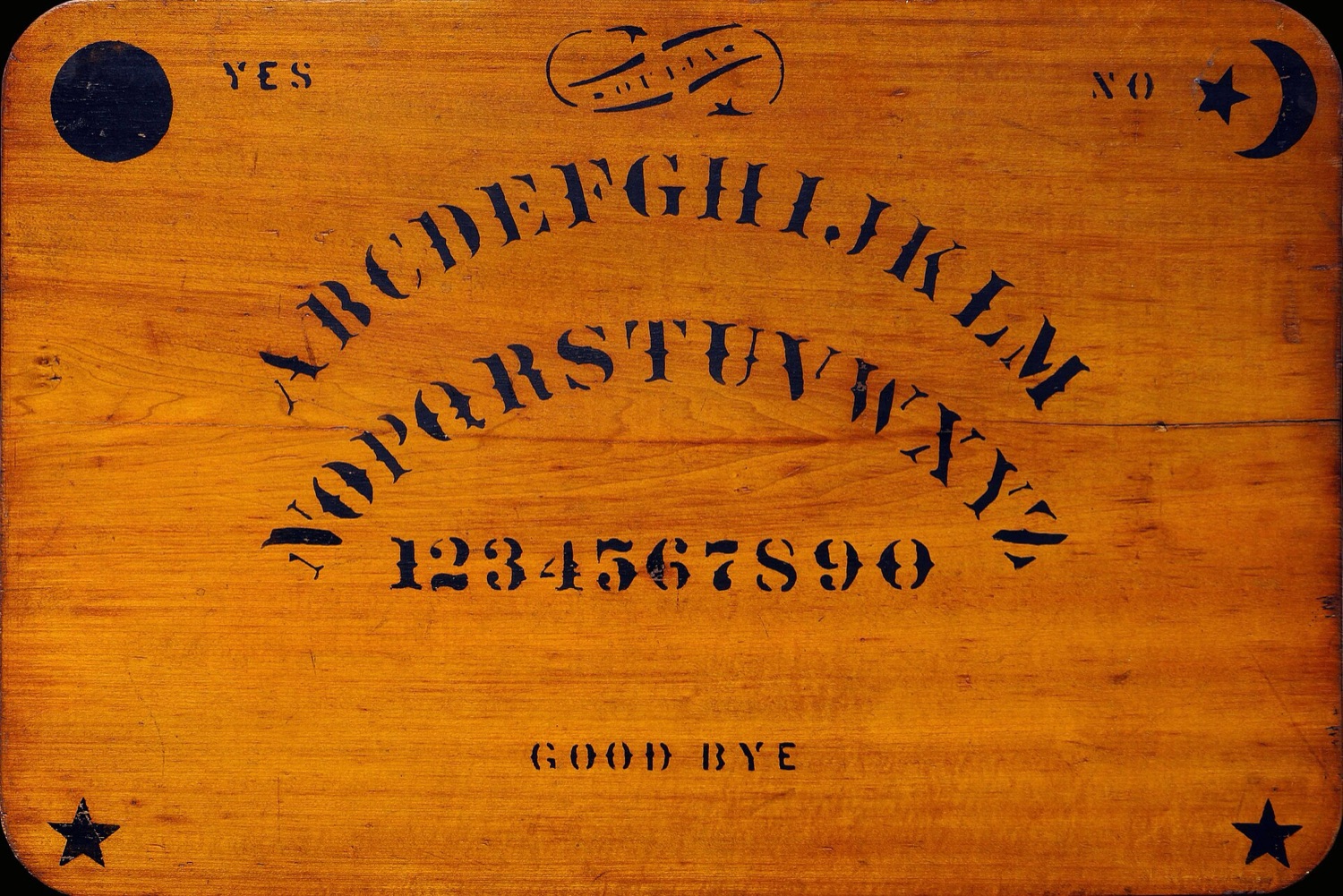
The boards of those first two years are the ones collectors mean by ‘Kennard’: stencilled maple, the sun and moon in the corners, the alphabet in two arcs, and a pointer that was a plain small planchette. There are very few of them. The company’s foreman, William Fuld, took over the business within a few years, put his own name on the board, fought his former partners and his own brother in court for the trademark, and built a factory on Harford Avenue that turned out Ouija boards for the next thirty years. He died in 1927 falling from its roof while supervising a flagpole, and the board stayed in his family until 1966, when they sold it to Parker Brothers of Salem, Massachusetts, who moved it to a town famous for hanging witches and, in 1967, sold two million of them, more than Monopoly.
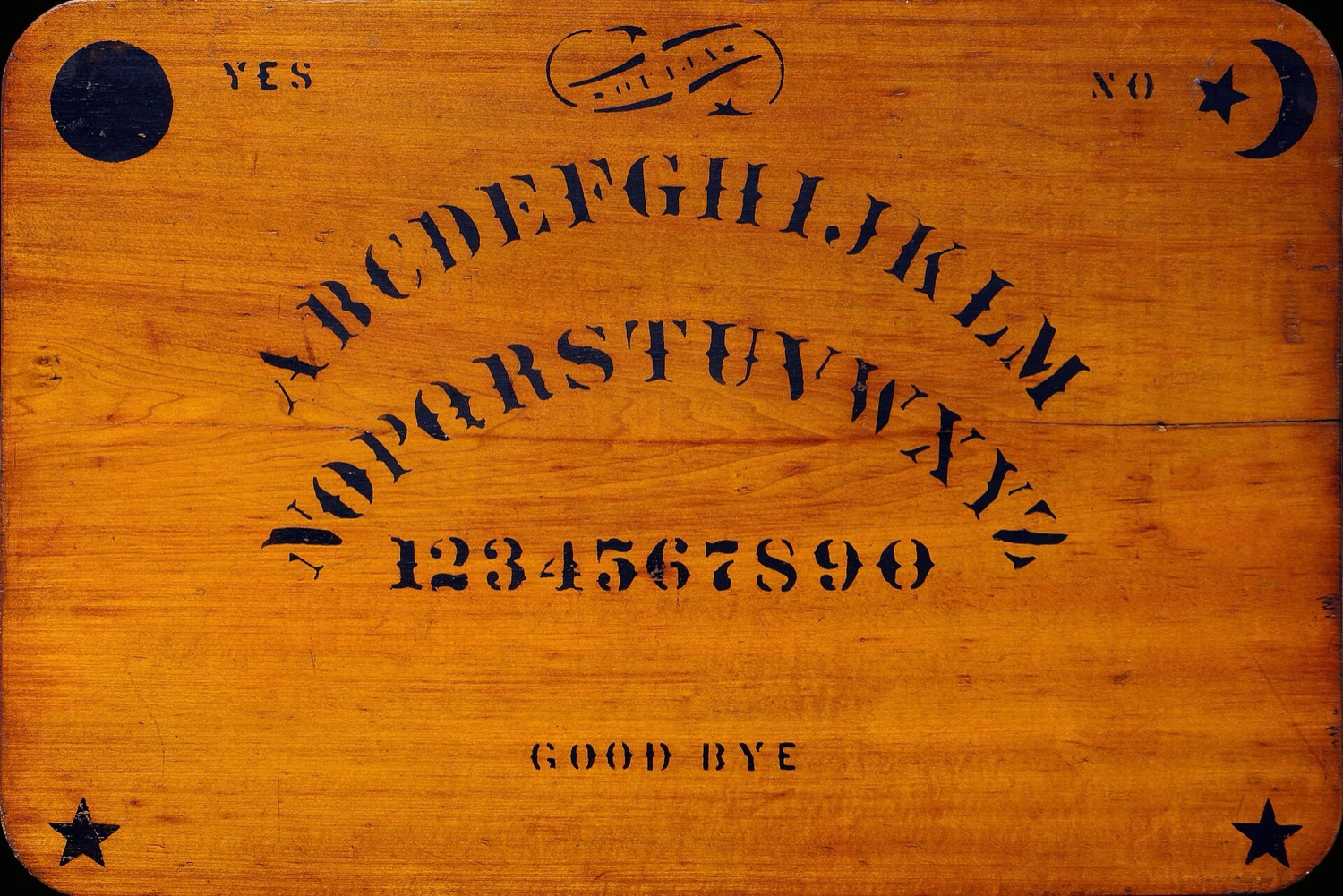
Between those dates the board had its seasons. During and after the Great War, with a generation of young men dead and the influenza taking the rest, it sold as it had not sold since 1890; in St. Louis in 1913 Pearl Curran began receiving, through a board, the novels and poems of a seventeenth-century spirit calling itself Patience Worth, which filled twenty-nine volumes and are still argued over; and in the spring of 1920 the newspapers of California reported an ‘Ouija fever’ in the town of El Cerrito, where a police court found seven people driven to distraction by their boards and the police chief proposed to ban them. Then the film. In 1973 The Exorcist opened with a girl playing with a Ouija board, and from that year the board belonged to horror rather than to grief. Hasbro bought Parker Brothers in 1991 and still makes it, in glow-in-the-dark plastic, with a plastic pointer. The board in our photograph is one of the handful of pre-trademark originals from 1890, and the hand on it is ours.
IIISet and Setting
The words are Timothy Leary’s, from the 1960s: set is what you bring to an experience, your expectation and your state of mind; setting is the room you have it in. He was talking about drugs, and the finding was that the same dose produced bliss in one room and terror in another. But the principle is older than any laboratory, and the people who built the great churches understood it perfectly.
The cottage and the cathedral
A twelfth-century peasant lived in one room of wattle and daub or rough timber, two and a half metres to a smoke-blackened roof, lit by the fire and a door. The nave of Chartres is thirty-seven metres to the vault and lit by a hundred and seventy windows of coloured glass. Walk from the first into the second and something happens to you that has nothing to do with what you believe.
Abbot Suger, rebuilding Saint-Denis outside Paris in 1144, wrote down what he was doing: the light through the glass, he said, lifts the mind from the material to the immaterial. He was describing setting. A man who lived in a hut and entered that building was not in a position to be sceptical; the building had already had its way with him before the Mass began. Modern psychology has caught up, slowly. The experience is now called awe, and it has been measured: it makes people feel small, patient, generous, and credulous; it makes them lose track of time; and it is reliably produced by height, by scale, by light, and by silence. A study of ceiling heights found that people think more abstractly under a high ceiling and more concretely under a low one. The cathedral builders did not need the study.
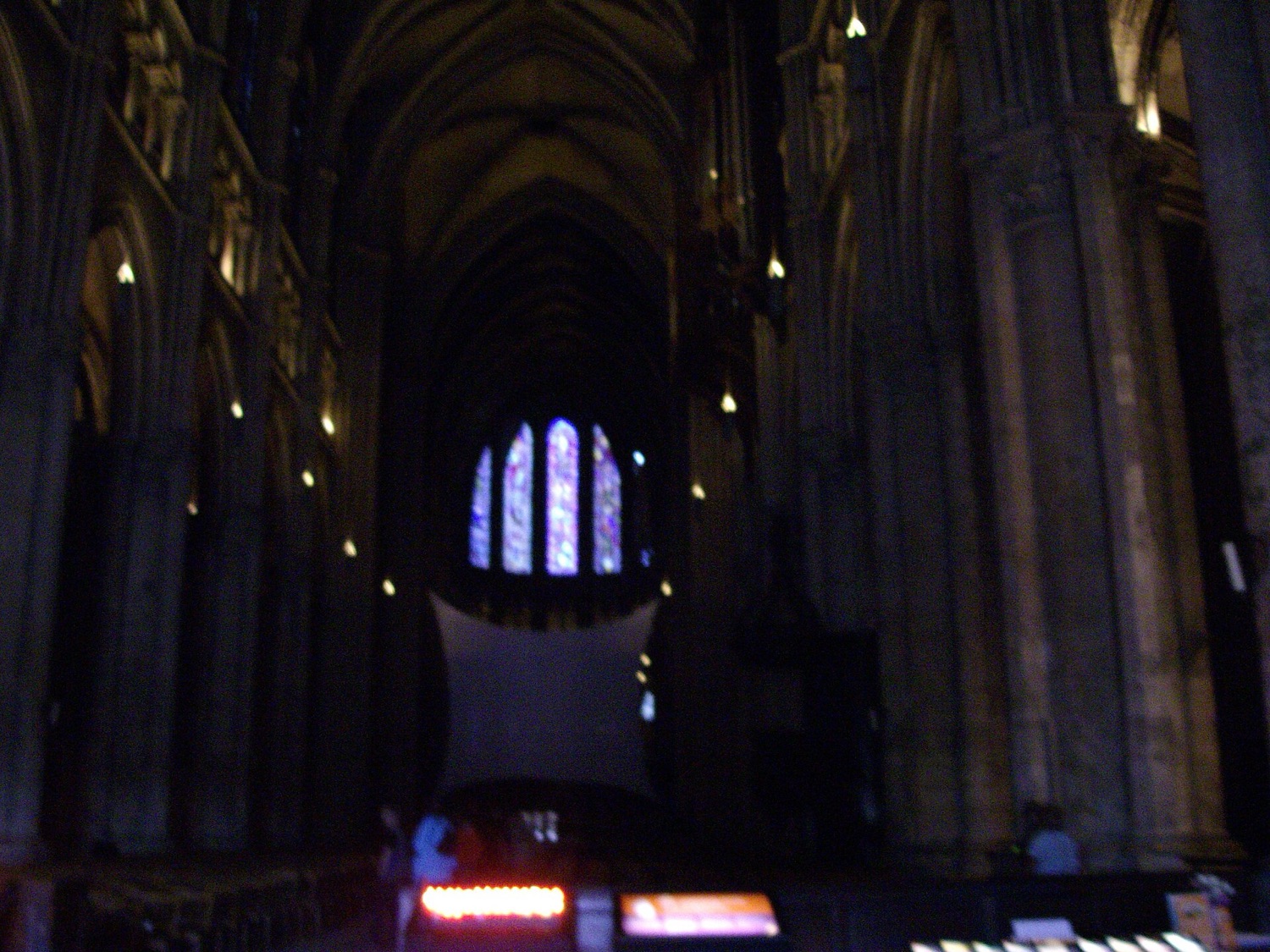
The séance was a setting too, and its builders were not fools. The darkened room, the circle of hands, the silence, the waiting, the single question asked aloud: every one of these is a device for putting the sitters into the state in which the hand moves and the mind accepts. The Victorians did not have the word ideomotor in their parlours, but they had the room, and the room worked. A board taken out of a box in a lit kitchen with the television on does nothing for anyone, and everyone who has tried it knows it. The same board, in a dark room, in a circle, with the right object on it, is a different instrument.
That is the second thing the skeletal planchette does, and it is the reason it is made of bone and not of plastic. Put a plastic pointer on the board and the setting is a game. Put a human hand of bone on it, the right size, with every joint where it should be, and the room changes before anyone has touched it. The sitters lower their voices. They sit up. They wait. The instrument has done to the room what the vault does to the peasant, and the sitting that follows is a different sitting. We have watched it happen at a hundred tables. It is not a trick; it is a setting, and it is the oldest technology there is.
IVSpirit Rapping, and the Rapping Hand
On the night of 31 March 1848, in a small frame house in Hydesville, New York, a girl of eleven named Kate Fox clapped her hands and said, to whatever had been knocking in the walls for a fortnight, ‘Mr. Splitfoot, do as I do.’ It knocked back the same number of times. Her sister Margaretta, fourteen, counted to four, and it knocked four. Their mother asked it the ages of her children, and it rapped them out correctly. She asked it to rap twice if it was a spirit, and it did. By the end of the night the neighbours were in the house and a code had been agreed: one rap for no, three for yes, and, for anything more, the alphabet recited aloud and a rap at the right letter. A peddler, the raps said, murdered in the house years before and buried in the cellar.
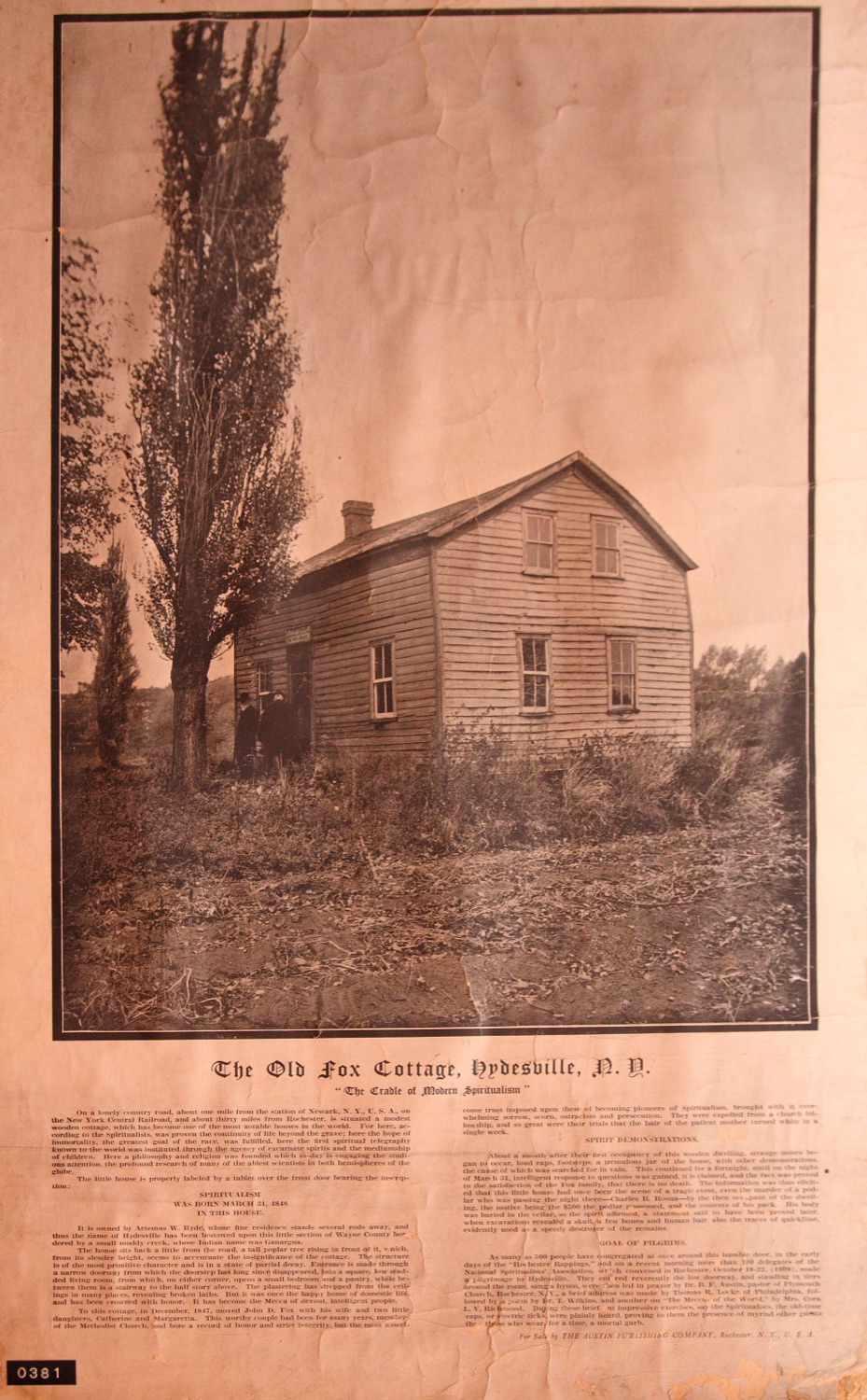
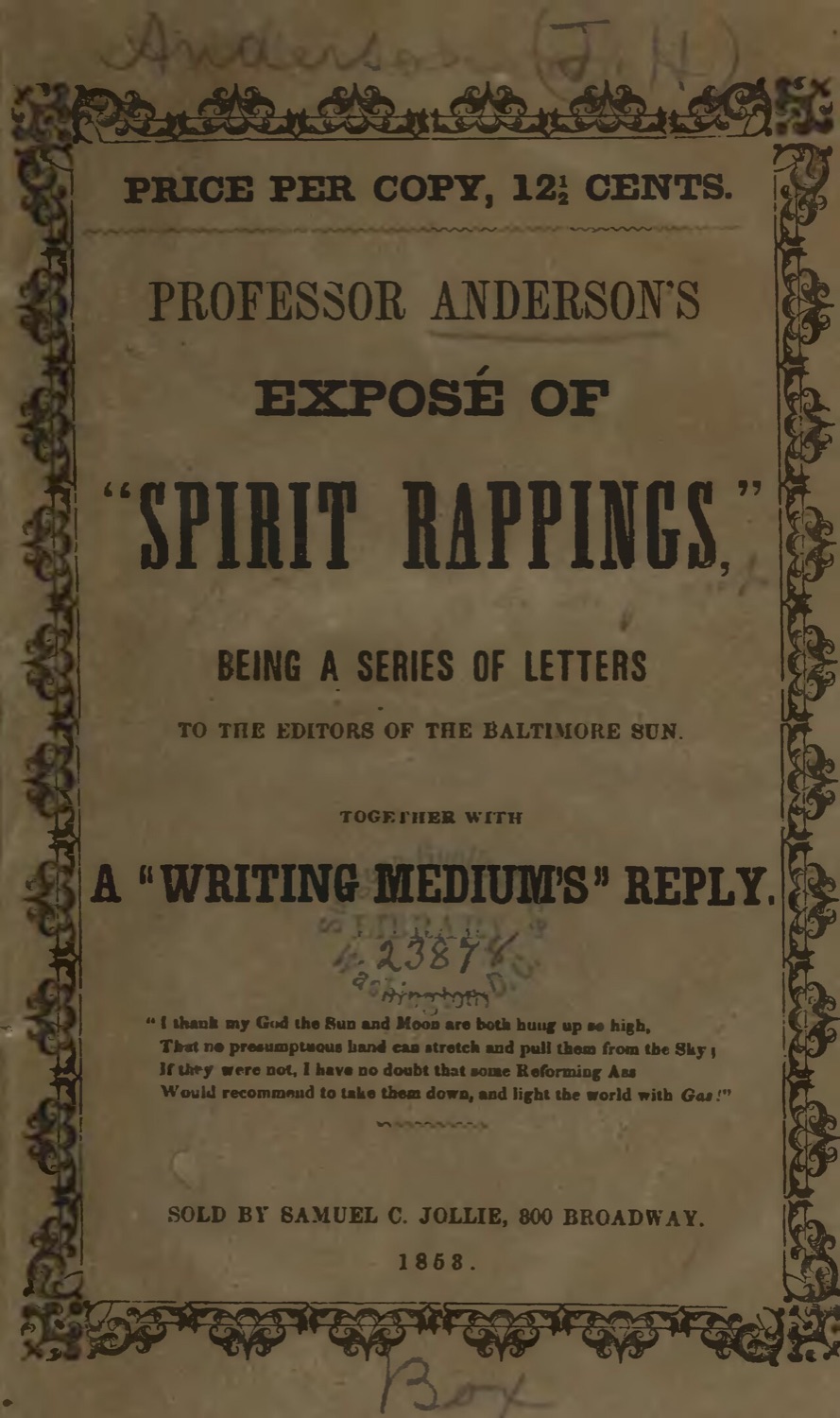
That code is the whole of it. Everything that came after, the planchette, the talking board, the Ouija, is a faster way of doing what the Fox sisters did with a knock: turning a yes-or-no signal into language. The rapping is the root, and it has never gone away; it is what a medium means by ‘physical phenomena’, and it is what the sitters at a table are listening for when the room goes quiet. The Fox girls went to Rochester, then New York, then everywhere; the raps followed them, and so did the doctors, who in Buffalo in 1851 announced that the sounds could be made by cracking the joints of the knee and the toe. Forty years later Margaretta stood on a stage in New York and demonstrated it, and a year after that took it back. It did not matter. By 1853 there were rapping circles in every town in the Union, and the books exposing them, of which two are on this page, sold as well as the books defending them.
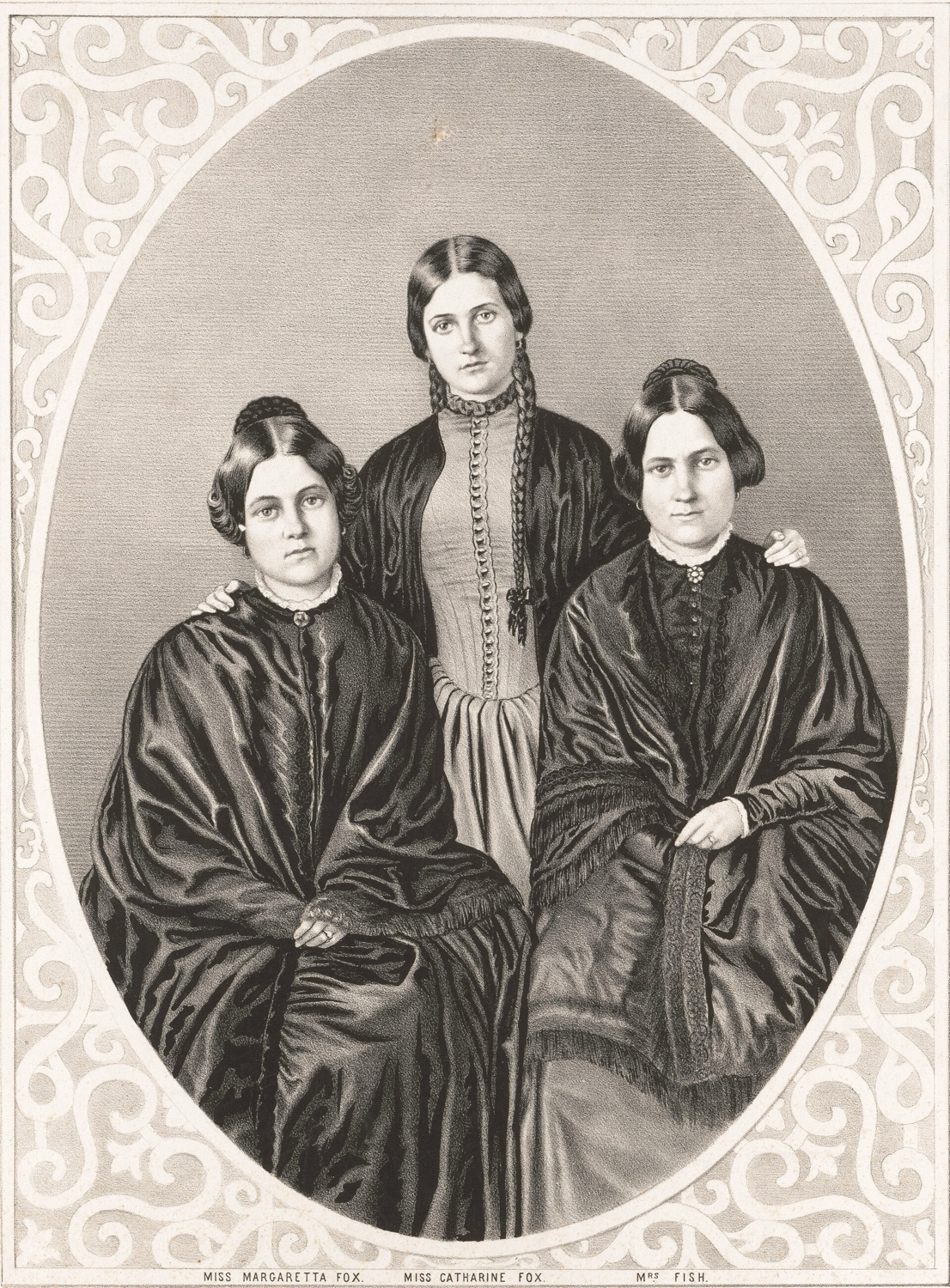
The code
Agreed in the Fox kitchen on the first night and never improved on. The tapping hand uses it unchanged.
The theatre took the raps up at once, because a rap is a wonderful thing on a stage. The great stage magicians of the 1850s, Anderson in London and New York, Robert-Houdin in Paris, put rapping tables and answering skulls into their programmes, partly to expose the mediums and partly because the audiences loved them. Robert-Houdin’s ‘enchanted death’s head’ sat on a sheet of glass on a table and nodded its answers; the Isola brothers used a wooden mask that rocked on an electromagnet; and a whole trade in ‘rapping hands’ grew up in the magic-shop catalogues: a carved or wax hand, cut off at the wrist, laid on a glass plate in full view, that rapped out the number of a card or the age of a lady in the front row. The secret was a thread, or later a wire and a magnet, and the effect was electric in every sense. By the 1890s the manuals gave you the wiring diagram. The engravings below are from Albert Hopkins’s Magic: Stage Illusions and Scientific Diversions of 1897, and they show the rapping skull and the rapping table as they were built.
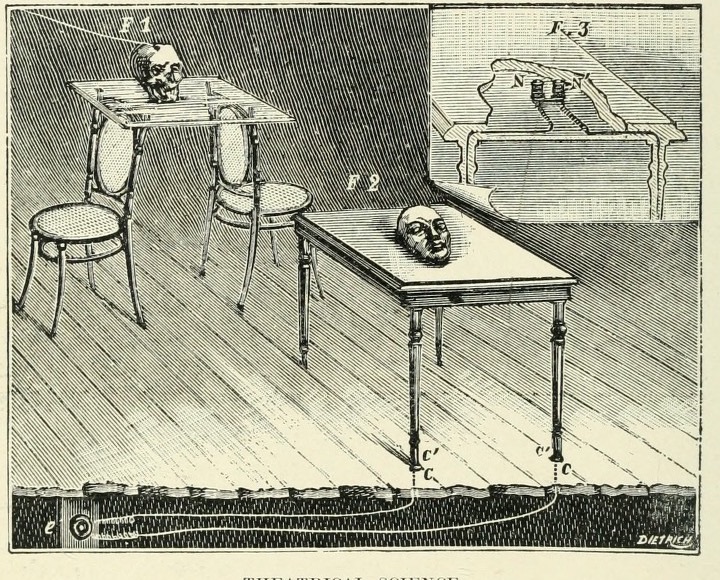
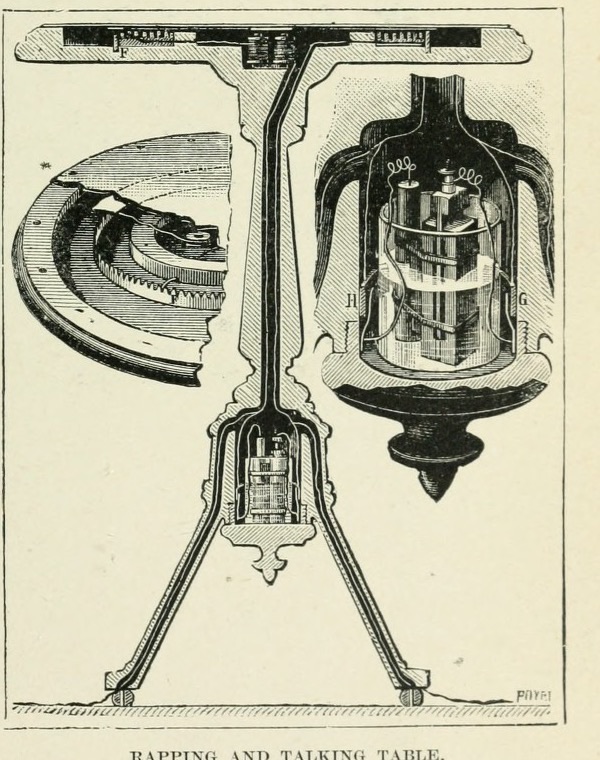
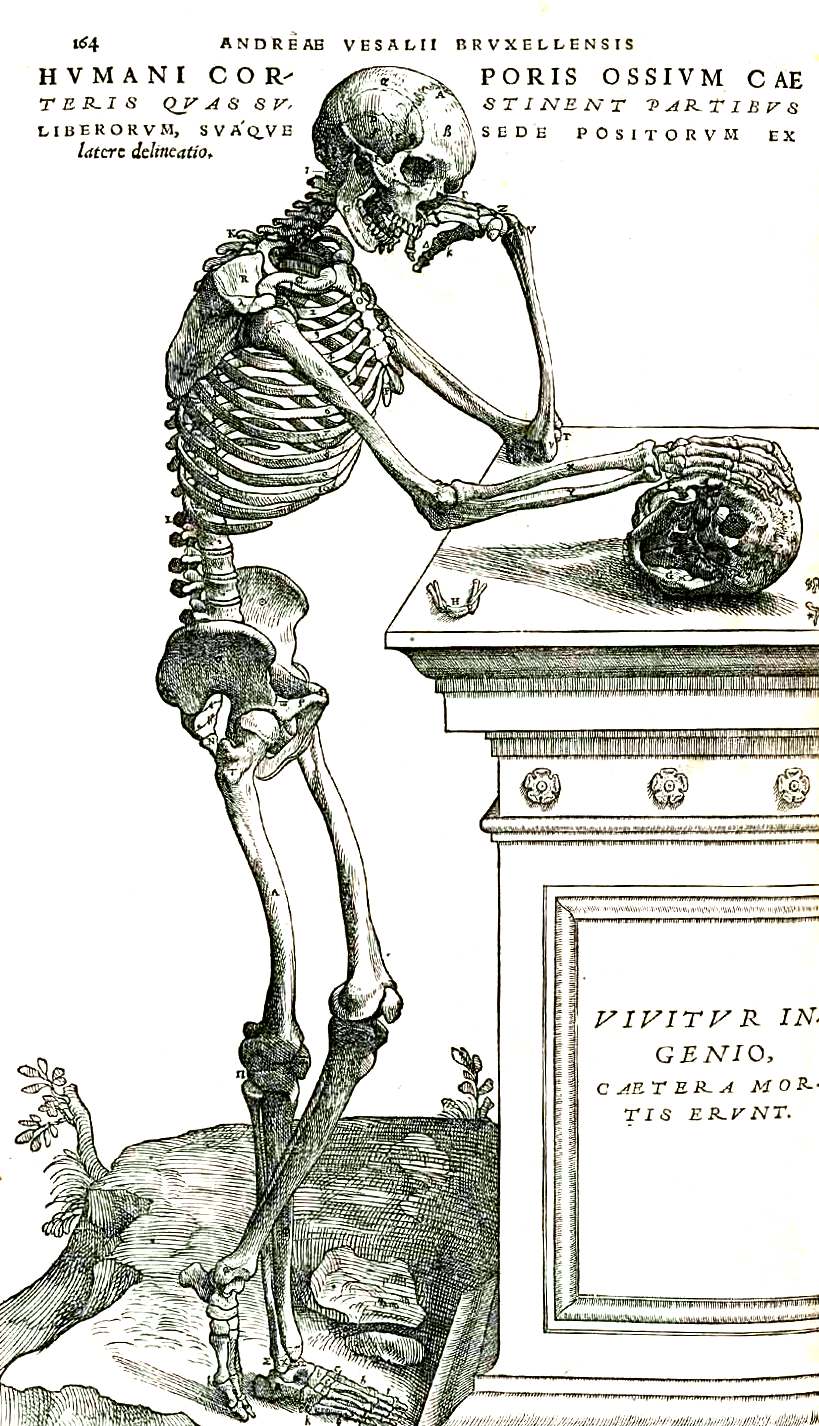
So there is a long line of hands and heads that rap: the spirit hands the mediums produced in the dark, the wax gloves of the 1920s séances, the rapping hands of the conjurers, the nodding skull of the Palais-Royal. What none of them ever was, in either camp, was a real hand: the mediums’ hands were the medium’s, and the magicians’ were carved. Ours is cast from the human skeleton, every bone, at life size, in a material that is itself half bone. It raps by the sitters’ own reflex and not by a thread, and it sits in the open on the table with nothing under it. The spiritualists and the conjurers would both have wanted one. We have made it for their descendants.

VFive: the Bones of the Hand
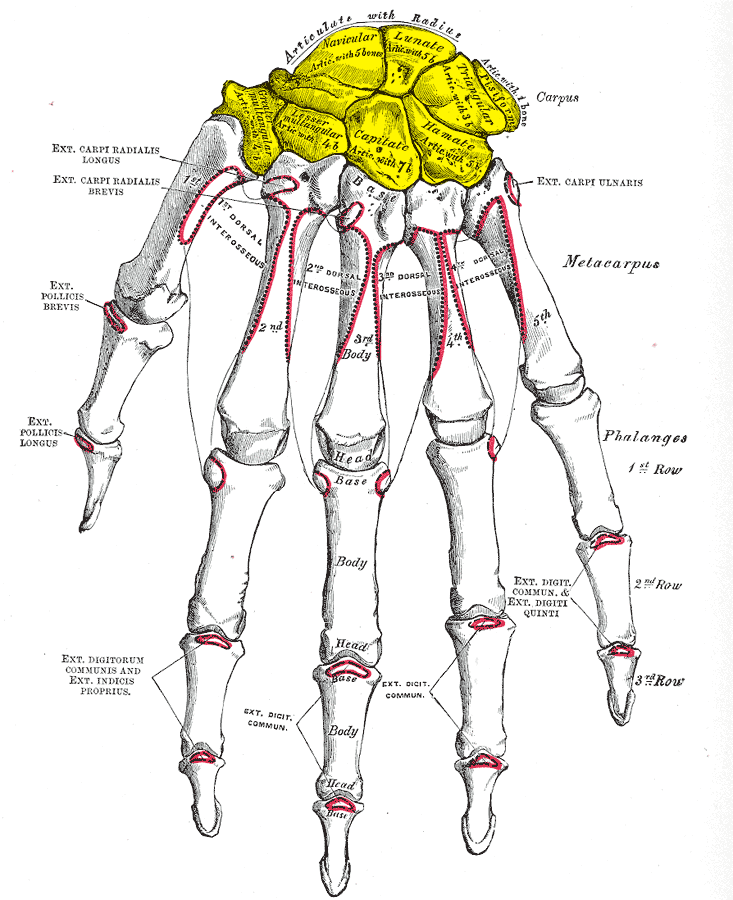
The human hand has twenty-seven bones. Eight small ones in the wrist, the carpals, in two rows of four; five metacarpals in the palm; and fourteen phalanges in the fingers, three to each finger and two to the thumb. It is the most complex mechanical assembly in the body and the one we know best, since it is in front of our eyes all day, and every human being alive has the same twenty-seven, in the same arrangement, built on the same number: five.
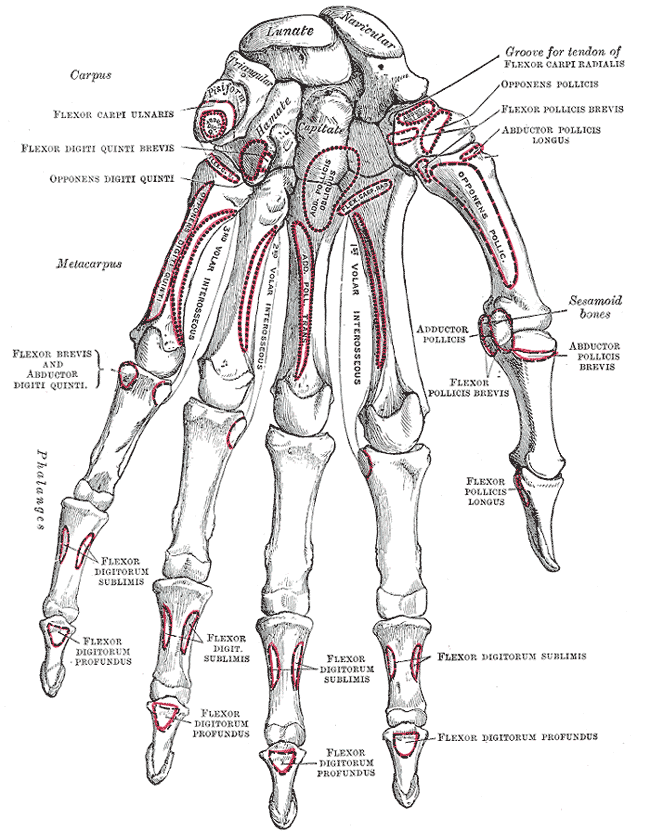
Five is not an accident and it is not a choice. Every land animal with a backbone, from the frog to the bat to you, is built on a five-fingered limb, the pentadactyl limb of the anatomists, and it was fixed some 340 million years ago in the first creatures that walked out of the water. Their ancestors had tried other numbers; the earliest of them, the Devonian Acanthostega, had eight fingers. Five is what survived, and it has never been changed since: the horse’s hoof is a single fifth finger with the others lost, the whale’s flipper has all five inside it, and your hand on the board is the oldest design you own.
Within the five, the proportion. Measure the bones of a finger from the tip inward and each is close to φ, the golden ratio, times the one before it: the distal phalanx, the middle, the proximal, the metacarpal, four lengths in a ratio of about 1 : 1.6 : 2.6 : 4.2. Close and not exact, because bone is grown and not drawn. The hand reads as beautiful for the same reason the pentagon does, and our sister workshop at Planchettes cuts its boards to that number for that reason. The skeletal planchette is not cut to φ. It is the thing φ was measured from.
Twenty-seven bones in five rays
Schematic, dorsal view, the bones of each finger drawn in golden proportion. Our modeller worked from the anatomical plates and from the skeleton itself, not from this drawing; but this drawing is what the skeleton is.
VIBone China
Bone china was invented in Stoke-on-Trent around 1796 by Josiah Spode, who was trying to make an English porcelain to compete with the Chinese and the Germans and found that half the recipe should be bone. Cattle bones, burned to ash and ground, mixed with kaolin and Cornish stone, fired in the bisque to about 1,250 degrees, then glazed and fired again: the result was whiter than any porcelain, translucent enough to see a hand through, and stronger than all of them. It became, and remains, the standard English china: Spode, Wedgwood, Royal Doulton, Minton, the whole of the Potteries. It is what the good cups are made of.
Half bone
Spode’s proportions, still in use: about fifty per cent bone ash, a quarter china clay, a quarter Cornish stone. The bone ash is what gives the ware its whiteness, its translucency, and its strength.
We chose it for the hand for two reasons, and they are the same two reasons as everything else on this page. The first is practical. A planchette is handled, dropped, packed, and used, and it taps: the fingertips strike wood thousands of times in the life of the instrument. Earthenware chips, plaster crumbles, resin looks like resin and dents. Bone china is the strongest of the ceramics, takes fine detail from the mould, holds a knife edge on the phalanges, and comes out of the glost kiln with the faint warm translucency of the real thing. Treated as an instrument, which is how it is meant to be treated, it will outlast the sitters.
The second reason is the one that made us do it. A skeleton hand made of bone china is a hand of bone made of bone. Half of its weight was once an animal’s skeleton; it has been through the fire twice; and it comes to the table as white and as hard as the thing it represents. The Victorians, who understood memento mori better than we do, would have liked that very much. So do we.
VIIThe Ossuary
The box the hand lives in is called the Ossuary, and the name is not a joke. An ossuary is a place for bones: the chest, chamber, or building in which the dead are kept once the grave has done its work and the flesh is gone. Every crowded culture has needed them, because graves fill and the dead keep coming, and some of the most extraordinary rooms on earth are the result.
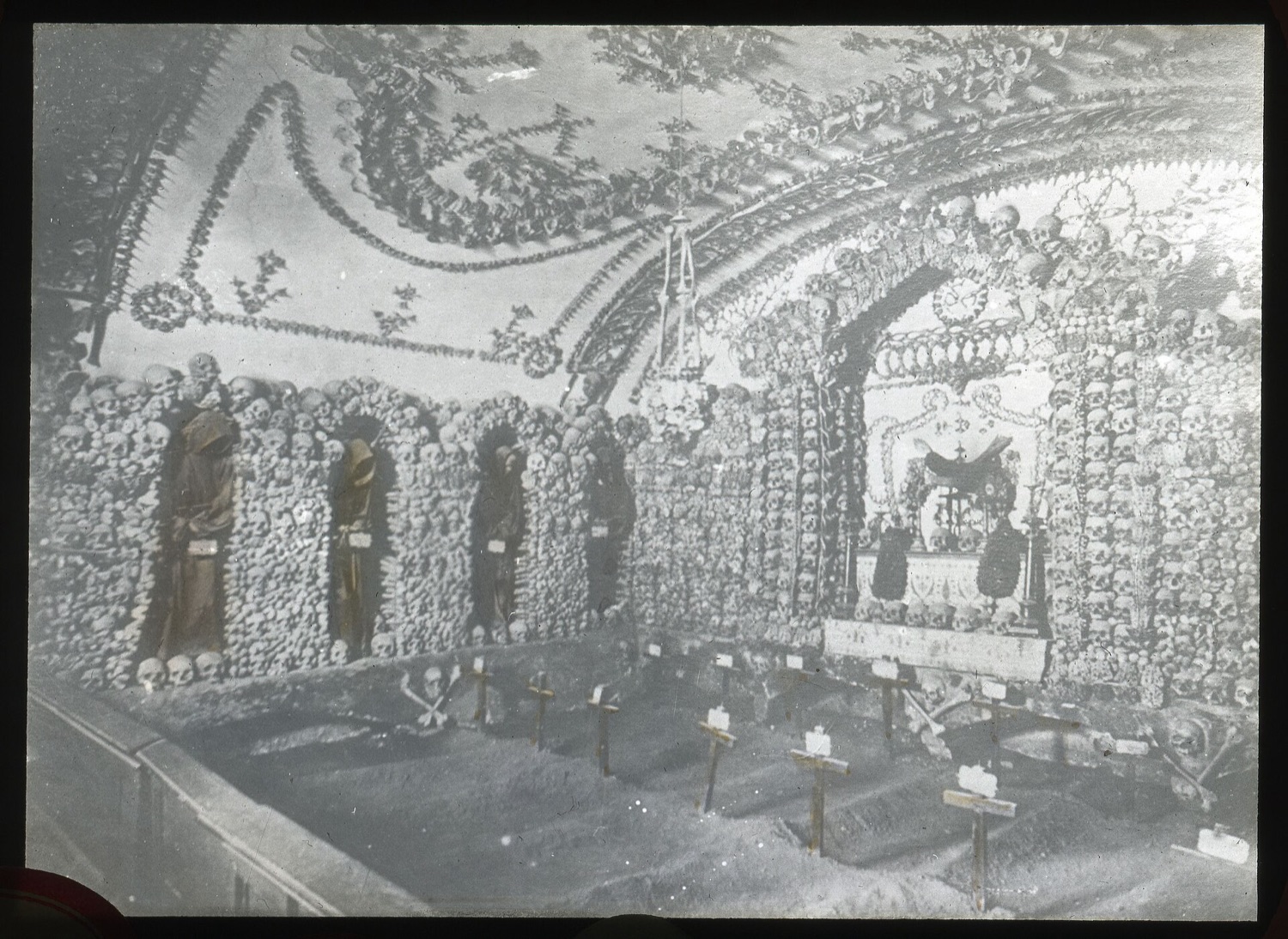
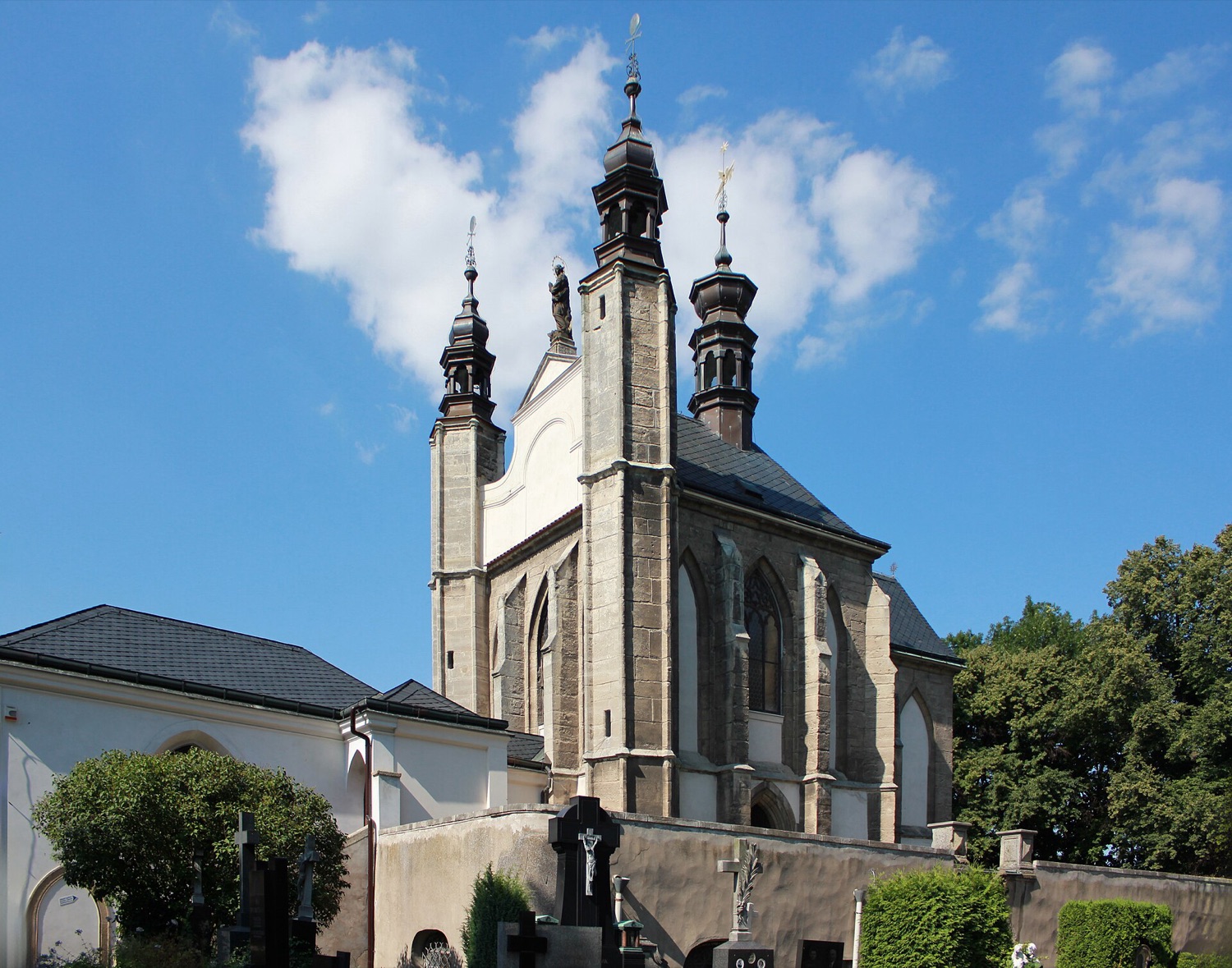
The Capuchin friars of Rome, from 1631, arranged the bones of their own dead brothers into the walls and ceilings of six small crypts under their church on the Via Veneto: arches of femurs, rosettes of vertebrae, a chandelier of finger bones, and a plaque that says what every ossuary says: what you are now, we once were; what we are now, you shall be. At Sedlec in Bohemia a woodcarver named František Rint was hired in 1870 to tidy the bones of forty thousand plague and war dead heaped in a chapel, and made of them a chandelier containing every bone in the human body, garlands, a coat of arms, and his own signature in bone. In the Salzkammergut, at Hallstatt, the graveyard was too small for the village, so for two and a half centuries the skulls were dug up after a decade, bleached, painted with the name and a wreath of flowers, and set on the shelves of the charnel house with their families. Under Paris six million people were moved out of the city’s cemeteries into the old quarries and stacked into walls by the quarrymen, skulls in courses like bricks.
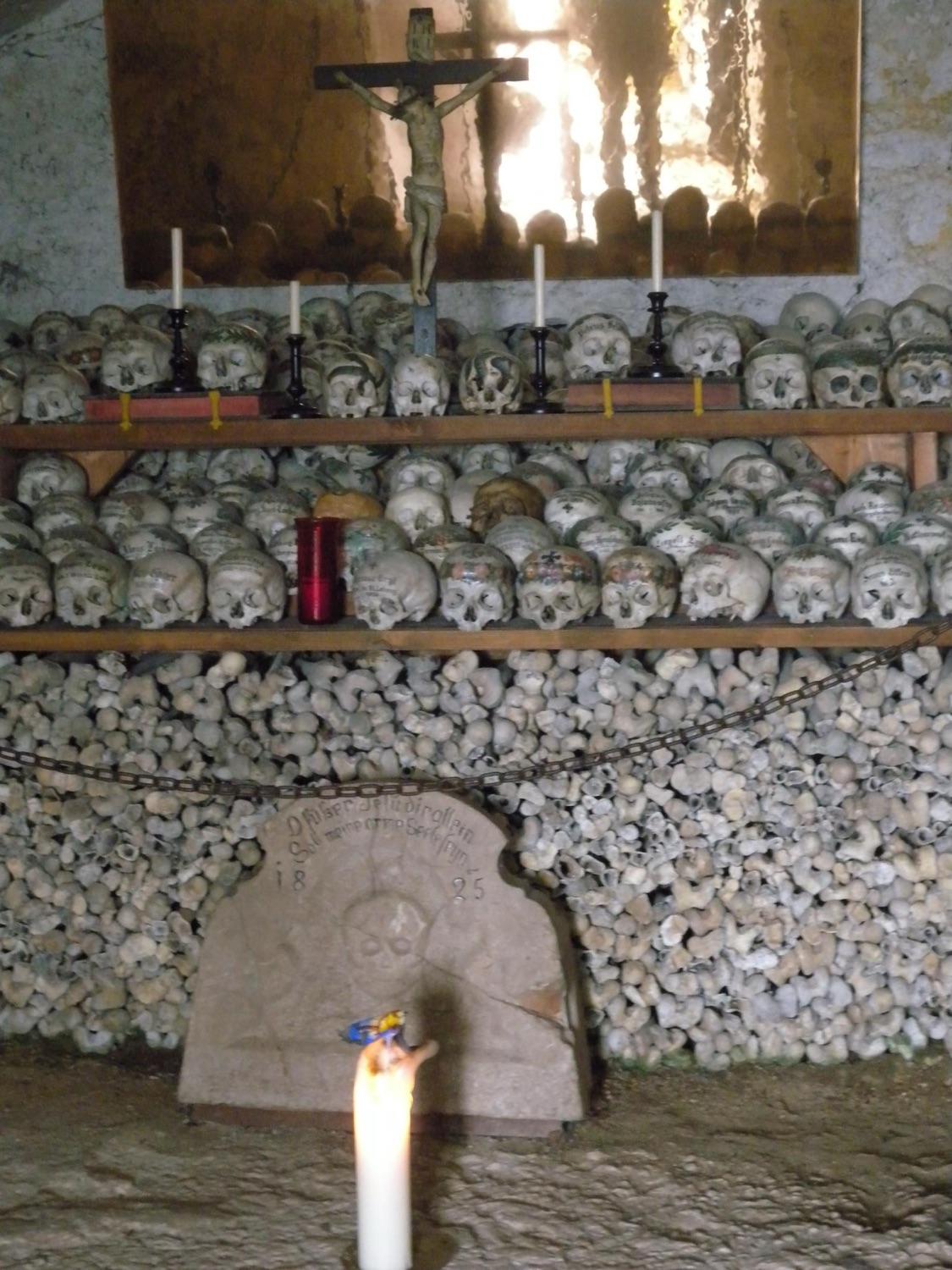
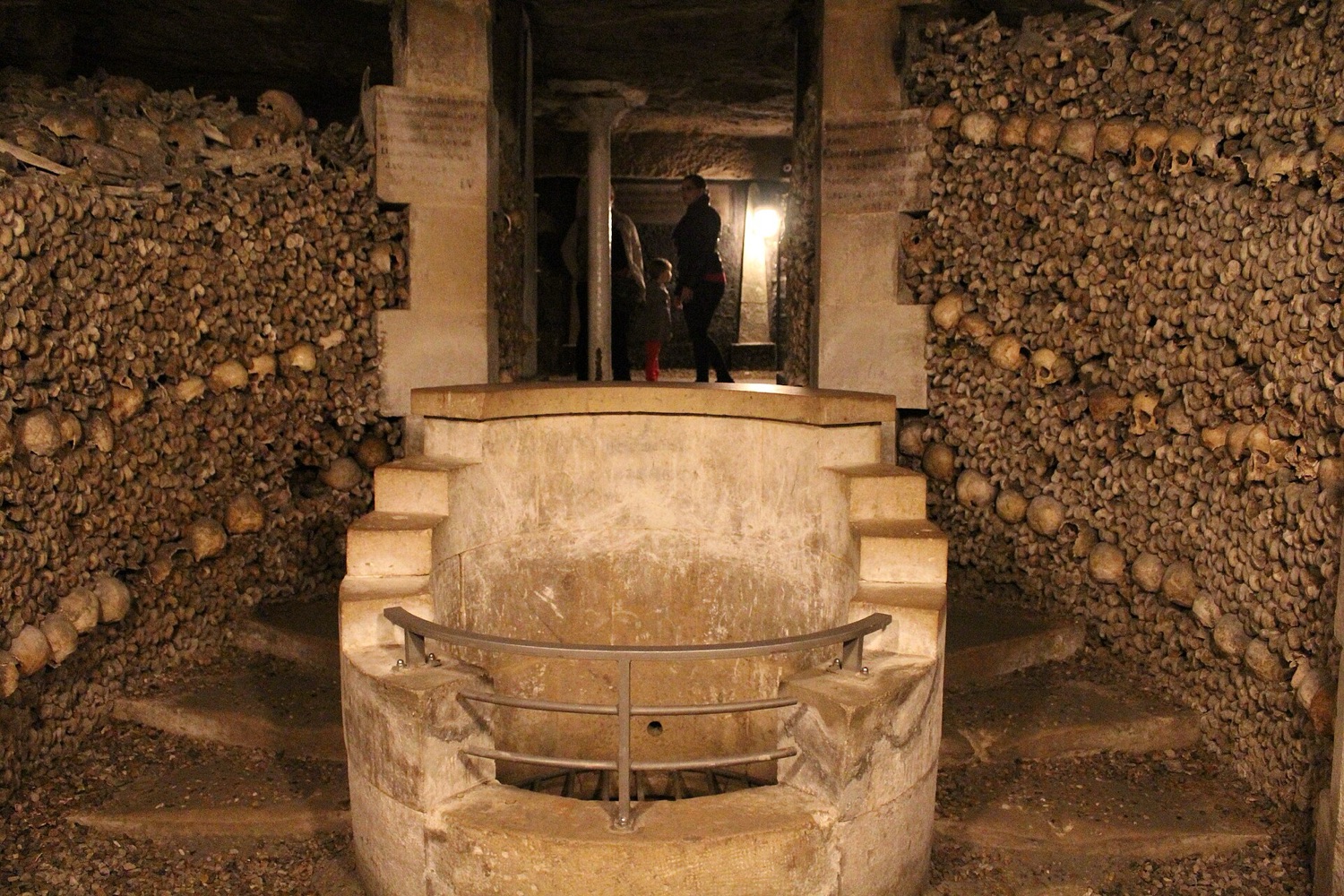
Older still are the small ossuaries: the limestone boxes of first-century Jerusalem, a cubit long, into which a family gathered the bones of its dead a year after burial, with the name scratched on the side; the reliquaries of the medieval church, in which a saint’s hand, in particular, was kept in a case of silver shaped like a hand. A box for a hand of bone has, in other words, a two-thousand-year pedigree, and ours is made in that tradition: lidded, lined, fitted to the bones, with a plate for the number. It is not packaging. It is where the hand lives between sittings, and the opening of it is the first act of the ceremony.
VIIIMethod
A dark room, or a dim one; a board on a table that does not wobble; the sitters in a circle, or one sitter with the patience for it. Open the Ossuary. Lift the hand out by the wrist and set it at the centre of the board, fingers toward the alphabet. Each sitter rests two or three fingertips on the back of the hand, on the metacarpals, lightly, the elbows free. Do not push and do not hold back. Ask, aloud, one question at a time.
The hand moves as any planchette does, sliding on its points. When it slows over a letter, let the weight settle forward onto the extended finger and the tip will strike the board. That is the tap, and at first it will be soft and uncertain. It sharpens with use, exactly as the reflexes of any instrument sharpen with use, and within a few sittings the sitters will hear a clean knock at every letter without anyone deciding to make one. Write the letters down as they are tapped. Say good-bye at the end, and put the hand back in its box.
For rapping without a board: the hand on a bare, hard table, the fingertips on the metacarpals, and the code of 1848: one rap no, three yes, and the alphabet recited aloud for anything longer. Keep a book of every sitting, with the date, the sitters, the questions, and the answers, letter by letter. The book is the only thing that will ever tell you what the hand does over a year, and it is the part of the instrument that no maker can supply.
Care: the hand is bone china and will survive a fall onto carpet and not onto tile. Wipe it; do not soak it. Keep it in the Ossuary. Do not lend it, for the same reason a violinist does not lend a violin.
IXThe Maker
We have made planchettes for more than twenty years under the name Paranormal Products, and the skeletal planchette is the one we spent the longest on. The idea is simple and the construction is not: a hand that is anatomically right, that rides a board without catching, that balances so that the tap comes from the finger and not from the wrist, and that can be cast and fired in bone china without warping in the kiln, took decades of failed moulds, cracked castings, and hands that looked right and did not work. This one works. It is the instrument we always meant to make, and it is, as far as we can find, the only one of its kind anywhere.
The photograph at the top of this page is our hand on one of the handful of original Kennard boards still in existence, made in 1890 before the trademark was even issued, and it is there because that is the company the hand keeps. We regard the making of these as a calling rather than a product line: it is our dharma to make them, and we make them slowly, by hand, in small numbers, each in its Ossuary, each numbered. The rest of what we make is at Planchettes, Pendulum Boards, Talk to the Dead, and Paranormal Products.